
Government Contractor Cash Flow: The Hidden Cost of Federal Payment Delays
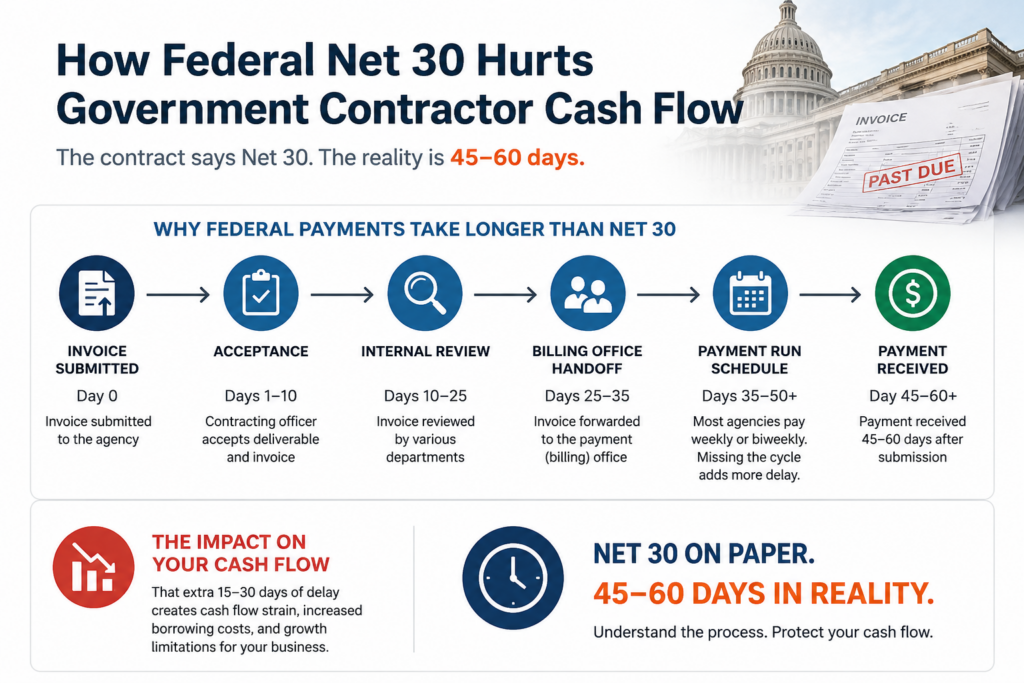
Government contractor cash flow is one of the most misunderstood challenges in federal business. While the Prompt Payment Act requires agencies to pay within 30 days of a proper invoice, many contractors routinely experience payment cycles closer to 45–60 days — because the statutory clock does not begin until a proper invoice is received and accepted. That distinction is not a technicality. It is the difference between planning your business around 30 days and absorbing the cost of 60.
How Federal Net 30 Hurts Government Contractor Cash Flow
The Prompt Payment Act is on your side — but only if you understand what triggers it.
The 30-day clock does not start when you submit an invoice. It starts when the agency receives a proper invoice — and the definition of proper is strict. A missing contract number, incorrect CLIN reference, absent EFT banking information, or any documentation gap the contract specifies can reset the clock entirely. No one is required to notify you that it happened.
By the time a valid invoice clears submission, acceptance, internal review, billing office handoffs, and the agency’s payment run schedule — which may be weekly or biweekly — 45 to 60 days is a routine outcome. Not a worst case. Routine.
Why Federal Payments Take Longer Than Net 30
Even when an invoice is submitted correctly, several layers inside the federal payment system add time before funds move:
- Proper invoice requirements — the invoice must meet every documentation standard in the contract before the 30-day clock begins
- Acceptance — the contracting officer or designated representative must formally accept the deliverable or service before the invoice is considered proper
- Payment office processing — the finance and payment office (separate from the contracting officer) handles actual disbursement and operates on its own review and approval cycle
- Payment run schedule — most federal payment offices run disbursements weekly or biweekly; missing a cycle by one day adds another full cycle to your wait
- New contract setup — the first invoice on a new contract is almost always the slowest while the payment office establishes your account
Understanding each of these stages gives you the ability to manage them — and to identify exactly where a delayed payment is stuck.
What Federal Payment Delays Cost Government Contractor Cash Flow
Most contractors absorb this delay without measuring it. That is a mistake that quietly erodes government contractor cash flow year after year.
Every dollar sitting in accounts receivable has a cost. Your business has a cost of capital — the rate you pay to borrow money, maintain a line of credit, or the opportunity cost of cash unavailable for reinvestment. When applied to unpaid receivables sitting for 30 extra days, the number is not theoretical. It is real and it compounds across every invoice cycle.
| Example:
$500,000 annual federal receivables 8.25% cost of capital 45 days outstanding instead of 30 ≈ $5,100 annual carrying cost
On $2M in receivables, that is over $20,000 annually — before factoring in any credit line used to bridge payroll. |
Some contractors price payment delays into their rates. That is a legitimate strategy — but it raises your bid and creates competitive pressure. The better move is to reduce the float itself.
The Prompt Payment Act: Know Your Rights
When a federal agency fails to pay a proper invoice within 30 days, it owes interest at a rate set by the Treasury Department and updated periodically. Some agencies pay it automatically. Many do not unless the contractor requests it. The amounts on any single invoice are small. Across a year of federal work with multiple contracts, they add up.
Practical steps most contractors miss:
- Verify IRAPT acceptance status — not just submission. Submitted and accepted are two different statuses. An invoice sitting in submitted is not being processed.
- Follow up with the payment office directly, not the contracting officer. COs do not process payments. The finance office does, and they have a separate contact number.
- Document every invoice submission with a timestamp and confirmation. If the clock is disputed, you need the record.
- Request Prompt Payment Act interest explicitly on any invoice that clears 30 days without payment.
Why Government Contractors Have a DSO Problem
DSO — Days Sales Outstanding — is the average number of days between an invoice and collected cash. In most commercial B2B, average DSO on Net 30 terms runs about 45 days. In government contracting, DSO regularly runs 60 days or longer on the first invoice cycle of a new contract.
That means the cash flow gap between delivering work and getting paid is wider for government contractors than for most commercial suppliers — even though the federal government is considered the most creditworthy payer in the world. The government will pay. The question is when. And the time between now and then has a cost.
Where Level 3 Processing Fits In
Invoice factoring and lines of credit are the most common tools contractors use to bridge the float. Both work. Both cost money.
Level 3 payment processing is a less commonly discussed tool — but for government contractors who accept card payments from agencies or prime contractors using [virtual cards] or [purchasing cards (P-cards)], it addresses a different part of the cost equation. While Level 3 processing does not make the government pay faster, it can reduce one of the other costs associated with delayed cash flow by lowering interchange expenses on eligible card payments — providing the standard electronic funding timeline associated with card acceptance while qualifying transactions for significantly better rates.
Level 3 processing requires submitting line-item detail — item descriptions, quantities, unit prices, tax amounts — with each transaction. Most contractors processing card payments do not submit this data, which means they pay [commercial interchange rates] on transactions that qualify for significantly lower [government and large-ticket rates].
| The difference between a standard card rate and a Level 3 qualified rate on a $50,000 government procurement can be 1% or more — a meaningful number when card payments are a regular part of how an agency or prime pays you. |
How to Strengthen Government Contractor Cash Flow
The contractors who manage federal cash flow well treat it as a system, not a hope. Practically, that means:
- Build 60–90 days of operating reserves before taking on federal work. The first invoice cycle on a new contract is almost always the slowest.
- Submit a clean invoice every time. Compliance is not paperwork — it is cash flow. One missing field can cost two to four weeks.
- Know the agency’s payment run schedule. Missing a biweekly run by one day adds a full cycle to your wait.
- Track your DSO by contract and agency. Some pay consistently. Some do not. That history should inform how you price future work.
- Understand your cost of capital. If you carry a line of credit to fund payroll between invoice cycles, that interest is a real cost of doing federal business.
- Evaluate Level 3 processing if your agency or prime pays by card. The interchange savings can materially offset float costs over the life of a contract.
The Bottom Line on Government Contractor Cash Flow
Government contractor cash flow does not have to be a guessing game. Federal payments are slower than most commercial arrangements — but they are predictable once you understand the system. The Prompt Payment Act gives you legal footing. Disciplined invoicing and DSO tracking give you control over timing. And Level 3 processing gives you a tool to reduce costs when cards are in play.
The gap between Net 30 and 60-day reality is real. The question is whether your business is built to absorb it — or built to close it.
| Revolution Payments specializes in Level 3 processing for government contractors.
If your agency or prime contractor pays by purchasing card, virtual card, or other commercial card, Revolution Payments can review your current processing setup at no cost. We’ll determine whether your transactions qualify for Level 3 rates, identify missed interchange savings, and show you how much could potentially be recovered. |