
Is Your Level 3 Data Still Saving You Money? What B2B Merchants Must Know About Visa CEDP Right Now
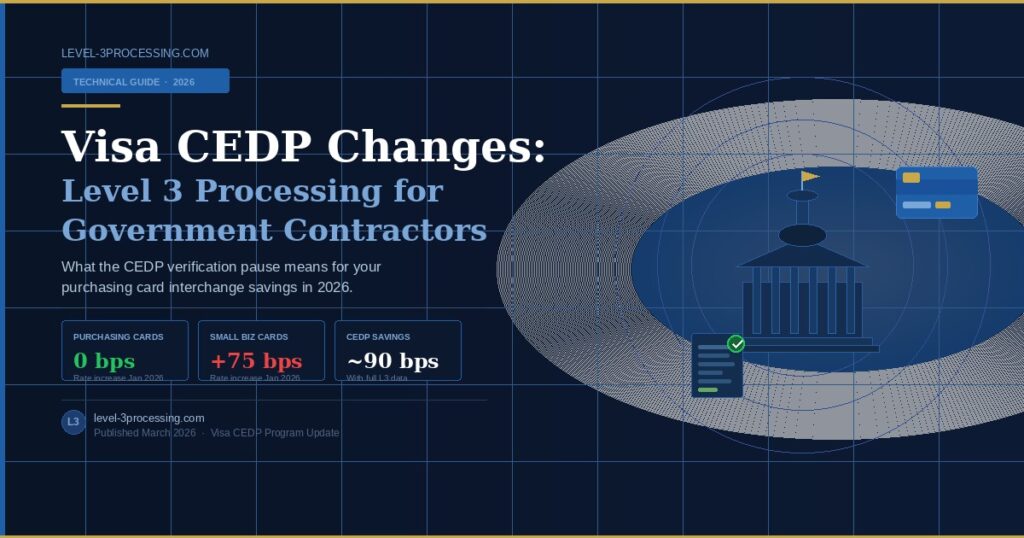
Level 3 processing for government contractors changed in two important ways in late 2025 and early 2026 — and most contractors haven’t heard about either one. Visa paused granting new CEDP verified status in November 2025, and then raised interchange rates on Small Business cards in January 2026. The good news: those rate increases did not touch purchasing card or corporate card rates, which means your direct cost exposure is limited. What does require action is the CEDP verification pause — because all interchange optimization now runs through a post-settlement data review, and incomplete Level 3 data means you forfeit the savings entirely.
Purchasing & Corporate Card Rates
Visa’s January 2026 rate increases did not apply to purchasing or corporate cards. Government contractor rates under CEDP are unchanged.
CEDP Verification Paused Since Nov 2025
New merchants cannot achieve verified status. All qualifying transactions now go through a lagged interchange review instead.
How Level 3 Processing Works for Government Contractors
Government contractors occupy a specific and advantageous position in the commercial card interchange ecosystem. Federal agencies — and many state and local government entities — pay contractors using purchasing cards (P-cards) and corporate cards. These card types are categorized by Visa as Corporate and Purchasing products, not Small Business cards, and they carry their own interchange rate structure under the CEDP program.
Level 3 processing refers to the submission of enhanced transaction data at the time of settlement — far beyond the basic cardholder and amount information transmitted in a standard consumer transaction. For government purchasing card transactions, Level 3 data typically includes:
The customer code or purchase order number associated with the government contract. Item-level detail: a description, quantity, unit of measure, and unit price for each line item on the invoice. Tax information: whether tax was charged, the tax amount, and whether the transaction is tax-exempt. Freight or shipping amounts if applicable. The merchant’s ship-from and ship-to postal codes.
When this data is submitted completely and accurately, transactions qualify for CEDP reduced interchange rates — which for purchasing and corporate cards represent the lowest interchange category available in the Visa commercial card program. The gap between a non-optimized commercial card transaction and a fully qualified Level 3 CEDP transaction can represent 90 basis points or more — a material cost difference at any significant volume of government receivables.
Development 1: The CEDP Verification Pause
Effective November 11, 2025, Visa suspended the granting of new verified merchant status under the Commercial Enhanced Data Program. The stated reason was a need to refine Visa’s adjudication processes — the internal methodology Visa uses to evaluate whether a merchant’s submitted transaction data consistently meets program standards.
For government contractors who were already on the verified merchant list before November 2025, the pause has no direct operational impact. Verified status continues, and transactions process at CEDP rates without change.
For contractors who have been implementing Level 3 processing in anticipation of CEDP verification — or who are new to the program entirely — the pause means full verified status is not currently being granted. Instead, Visa has implemented a post-settlement review mechanism called the lagged interchange process to ensure qualifying transactions are still credited appropriately during the pause period.
How the Lagged Interchange Process Works
Transaction Settles at the Standard Rate
When a purchasing card transaction settles, it initially clears at the standard commercial interchange rate — without any CEDP reduction applied upfront.
Visa Reviews the Level 3 Data After Settlement
Visa’s system evaluates the transaction data submitted against CEDP qualification requirements. This review occurs in the days following settlement, not in real time.
Qualifying Transactions Receive an Interchange Credit
If the transaction data meets CEDP standards, Visa posts an interchange credit to the merchant’s account. This credit typically appears 10 to 15 business days after the original settlement date.
Credit Appears as “Visa CEDP Verified” on Your Statement
Under pass-through or interchange-plus pricing, the credit will appear as a separate line item labeled “Visa CEDP Verified.” If you process under a bundled rate model, the credit may not be visible as a distinct line item — a critical reason to ensure you’re on transparent pricing.
The lagged process is not a guarantee — it is a post-settlement audit. Transactions that do not fully meet CEDP data requirements receive no credit and no partial adjustment. Either the transaction qualifies completely, or it does not qualify at all.
This binary outcome makes complete, accurate Level 3 data submission the single most important factor in interchange optimization for government contractors right now.
Development 2: The January 2026 Rate Increases — and Why Government Contractors Are Largely Protected
On January 24, 2026, Visa implemented significant interchange rate increases — 65 to 75 basis points — for Small Business Credit card products under the CEDP program. These increases generated substantial concern across the merchant community. For government contractors, however, the direct impact is limited, and understanding why requires understanding how Visa categorizes commercial card products.
Visa distinguishes between three primary categories of commercial cards: Small Business cards, Corporate cards, and Purchasing cards. Small Business cards are issued to individual business owners and small enterprises. Corporate cards and Purchasing cards are issued by organizations — including government agencies — for business expenditure management. The January 2026 rate increases applied exclusively to Small Business Credit products.
| Card Type | Base Rate | CEDP Verified Rate | Jan 2026 Change |
|---|---|---|---|
| Visa Corporate | $0.10 + 2.70% | $0.10 + 1.75% + 0.05% | No Change |
| Visa Purchasing | $0.10 + 2.70% | $0.10 + 1.75% + 0.05% | No Change |
| Program | Previous CEDP Rate | New CEDP Rate (Jan 2026) | Increase |
|---|---|---|---|
| Business Credit Level III – Tier 1 | 1.75% + $0.10 | 2.40% + $0.10 | +65 bps |
| Business Credit Level III – Tier 2 | 1.90% + $0.10 | 2.55% + $0.10 | +65 bps |
| Business Credit Level III – Tier 3 | 1.95% + $0.10 | 2.60% + $0.10 | +65 bps |
| Business Credit Level III – Tier 4 | 2.05% + $0.10 | 2.70% + $0.10 | +65 bps |
| Business Credit Level III – Tier 5 | 2.10% + $0.10 | 2.75% + $0.10 | +65 bps |
The practical implication: if your commercial card receivables are predominantly from federal agency purchasing cards and corporate travel cards, your interchange rates were not materially affected by the January 2026 changes. Where exposure exists is in contractors who may also accept payment from small business subcontractors or private-sector clients using Visa Small Business cards.
Why Data Quality Is Now the Critical Variable
With CEDP verification paused and all interchange optimization running through the lagged review process, the quality and completeness of your Level 3 data submission determines whether you capture the savings or forfeit them. There is no middle ground in the lagged process — transactions either qualify fully or they don’t qualify at all.
The following are the most common Level 3 data failures that cause purchasing card transactions to fail the CEDP review. Each of these is preventable with proper configuration of your payment gateway or accounting system integration.
Common Level 3 Data Failures for Government Purchasing Card Transactions
Missing or Incorrect Customer Code / Purchase Order Number
Government purchasing card transactions are typically tied to a specific purchase order or contract number. This field is required for CEDP qualification and must match the data on the cardholder’s account. Submitting a blank value or a placeholder is a disqualifying error.
Pre-Authorization Amount Does Not Match Settlement Amount
Purchasing card transactions often involve estimated authorizations that differ from final invoiced amounts. If the settlement amount exceeds the authorized amount by more than the card’s tolerance threshold, the transaction may not qualify for Level 3 rates regardless of data quality.
Settlement Delay Beyond 48 Hours
Transactions must be settled within 48 hours of authorization to qualify for CEDP rates. Government invoicing cycles can create gaps between when services are rendered, when the card is authorized, and when the transaction is actually settled. Delays beyond the 48-hour window will disqualify a transaction from Level 3 interchange — regardless of data completeness.
Incomplete Line-Item Detail
Level 3 requires item-level data: product or service description, quantity, unit of measure, and unit price for each line on the invoice. A transaction submitted with a single summary description rather than itemized line-level data will typically fail the CEDP review, even if all other fields are present.
Tax Amount Discrepancy or Missing Tax Indicator
Government transactions are frequently tax-exempt, and many Level 3 submissions incorrectly omit the tax indicator field rather than explicitly indicating zero tax. The field must be present and populated — either with the tax amount or with a tax-exempt indicator — for the transaction to pass validation.
Missing Ship-From or Ship-To Postal Codes
Both the originating postal code (your location) and the destination postal code (the agency or delivery location) are required fields. Contractors delivering services at federal facilities sometimes leave the ship-to code blank or submit the contractor’s address for both fields — both are disqualifying errors.
What to Review and Verify Right Now
Given the shift to the lagged interchange process, the following review process will confirm whether your Level 3 data is successfully qualifying and whether you’re capturing the interchange savings you’re entitled to.
Step 1 — Look for CEDP credits on your January and February 2026 statements. Under pass-through or interchange-plus pricing, you should see line items labeled “Visa CEDP Verified” appearing 10 to 15 business days after your settlement dates. If you are consistently submitting Level 3 data and these credits are not appearing, your transactions are failing the post-settlement review.
Step 2 — Compare your expected interchange rate against what’s actually being charged. For fully qualified purchasing card transactions under CEDP, the effective rate should be approximately $0.10 + 1.75% plus the 0.05% CEDP network fee. If your statements show rates materially higher than this on purchasing card transactions, there is a qualification gap.
Step 3 — Audit your payment gateway’s Level 3 field configuration. Many Level 3 implementations pass some required fields but leave others blank or incorrectly populated. A configuration review against the specific CEDP field requirements for purchasing cards — not just a generic Level 3 checklist — will identify the precise gaps causing disqualification.
Step 4 — Verify your settlement timing relative to authorization dates. Pull a sample of transactions and confirm that settlement is occurring within 48 hours of authorization. If your accounts receivable process involves a delay between service delivery and card settlement, this may be the primary disqualification driver — and it requires a process change, not just a data fix.
Frequently Asked Questions
No. Merchants who achieved CEDP verified status before the November 11, 2025 pause retain their verified status and continue to process at CEDP rates without interruption. The pause affects only merchants seeking new verification. If you were verified before that date, your program enrollment is unchanged.
Yes. Visa categorizes government purchasing cards and corporate cards separately from small business cards, and they carry distinct interchange rate schedules. Under CEDP, purchasing and corporate cards qualify for the lowest available commercial interchange rates — and those rates were not affected by the January 2026 increases that impacted Small Business card products. This distinction is significant for government contractors whose receivables are predominantly on purchasing cards.
Under pass-through or interchange-plus pricing, qualifying transactions will generate a credit line on your processing statement labeled “Visa CEDP Verified,” typically appearing 10 to 15 business days after the original settlement date. The credit amount represents the difference between the standard rate charged at settlement and the CEDP rate the transaction qualified for. If you are submitting Level 3 data and not seeing these credits, your transactions are not passing the review — and a data audit is warranted.
Yes, and for government contractors it is particularly important. The lagged interchange process means qualifying transactions still receive the CEDP rate benefit — just through a post-settlement credit rather than upfront pricing. The interchange savings available on purchasing card transactions are among the largest available in the commercial card ecosystem. Pausing Level 3 submission during the verification pause would forfeit those credits entirely. The verification pause is a temporary administrative hold, not a program discontinuation.
For a fully qualified purchasing card transaction under CEDP, the effective rate is approximately $0.10 + 1.80% (inclusive of the CEDP network fee). Compared to a non-optimized commercial card transaction at $0.10 + 2.70%, this represents a savings of approximately 90 basis points. For a contractor processing $500,000 per month in government purchasing card receivables, the annualized savings from full Level 3 CEDP qualification is approximately $54,000 per year.
Not necessarily. Many processors submit what they describe as Level 3 data, but the completeness and accuracy of that data varies significantly by platform and configuration. The lagged interchange review is Visa’s validation of whether the submitted data actually meets CEDP standards — not simply whether it was transmitted in a Level 3 format. The presence or absence of CEDP credits on your statement is the definitive test of whether your transactions are actually qualifying, regardless of what your processor says about their Level 3 capability.