

Government Contractor Profit Margins: The Hidden Costs Eating Into Your Profits
Government contractor profit margins are under increasing pressure. Between rising labor costs, growing compliance requirements, competitive contract pricing, and delayed payments, government contractors are being asked to do more with less. While winning additional contracts can increase revenue, it doesn’t necessarily translate into higher profits. With margins shrinking, it’s more important than ever for government…
+ Read More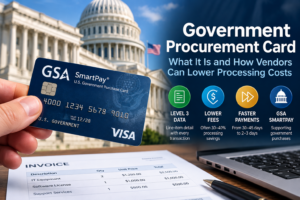
Government Procurement Card: What It Is and How Vendors Can Lower Processing Costs
A government procurement card, also commonly referred to in the United States as a government purchase card, purchasing card, or P-card, allows government agencies to purchase goods and services directly from vendors using a commercial credit card. For merchants and government contractors accepting these cards, there is an important opportunity that is often overlooked: Visa…
+ Read More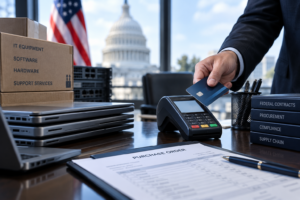
SEWP Contract Holders — Are You Accepting Government Purchase Cards Correctly?
For businesses that have recently been awarded a SEWP contract — NASA’s Solutions for Enterprise-Wide Procurement vehicle — the next step is getting set up to accept payment from federal purchasing agents. Most of those payments come by government purchase card. And while accepting a government purchase card looks straightforward on the surface, how that transaction…
+ Read More
GSA Large Ticket Interchange — What Government Contractors Are Leaving on the Table
The GSA large ticket interchange program is a Visa interchange category specifically created for government purchase card transactions above a certain dollar threshold. For government contractors — including GSA Schedule vendors, SEWP contract holders, and DoD suppliers — who regularly receive large purchase card payments from federal agencies, this program can significantly reduce the interchange cost on…
+ Read More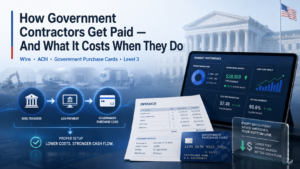
How Government Contractors Get Paid — And What It Costs When They Do
Understanding how government contractors get paid is one of the most practical — and most overlooked — aspects of doing business with the federal government. There are more resources than ever to help contractors win government contracts. The gap is on the other side: once the contract is awarded and the work is delivered, most…
+ Read More
Surcharging Government Purchase Cards — What Government Contractors Need to Know
Some government contractors are permitted to do surcharging on government purchase card transactions. Whether doing so makes sense is a different question — and for contractors who choose not to surcharge, there is a path to significantly lower interchange costs that most processors never mention. The question of whether government contractors can surcharge government purchase cards is…
+ Read More
Won a Government Contract — Now What About Getting Paid Correctly?
For any contractor asking won a government contract now what — the answer almost never includes what to do about accepting payments correctly. Winning a government contract is a significant achievement — and the government contracting industry has built an entire ecosystem around helping businesses get there. SAM.gov registration services, proposal writers, CAGE number consultants, bid…
+ Read More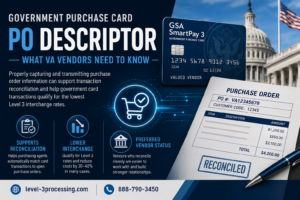
Government Purchase Card PO Descriptor — What VA Vendors Need to Know
For vendors accepting government purchase cards from federal agencies such as the Department of Veterans Affairs, properly capturing and transmitting purchase order information can be an important part of both transaction reconciliation and Level 3 interchange qualification. The challenge is that simply having a gateway that supports Level 3 does not necessarily mean every required data field…
+ Read More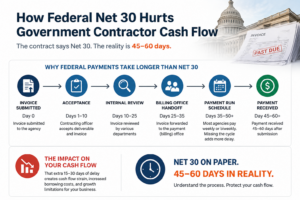
Government Contractor Cash Flow: The Hidden Cost of Federal Payment Delays
Government contractor cash flow is one of the most misunderstood challenges in federal business. While the Prompt Payment Act requires agencies to pay within 30 days of a proper invoice, many contractors routinely experience payment cycles closer to 45–60 days — because the statutory clock does not begin until a proper invoice is received and…
+ Read More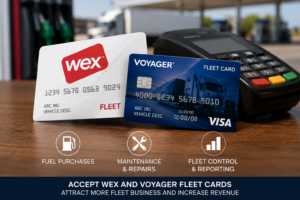
How to Accept Fleet Cards
If you want to accept fleet cards, you need more than a standard credit card processor. Fleet cards such as WEX and the U.S. Bank Voyager® Fleet Card require separate merchant enrollment, proper POS configuration, and the ability to capture additional transaction data. Whether you operate a gas station, truck stop, truck repair shop, heavy-duty…
+ Read MoreAbout Us
At Revolution Payment Systems, our entire focus is on delivering reliable and secure payment solutions to help businesses succeed in an increasingly complex global marketplace.
Connect With us
Revolution Payment Systems is a registered ISO of Wells Fargo Bank, N.A., Walnut Creek, CA. American Express requires separate approval.
www.revolution-payments.com Revolution Payment Systems is an Elavon Payments Partner & Registered ISO/MSP of Elavon, GA
© 2016 Revolution Payments | Privacy Policy | Website Developed by Silentblast