
Government Procurement Card: What It Is and How Vendors Can Lower Processing Costs
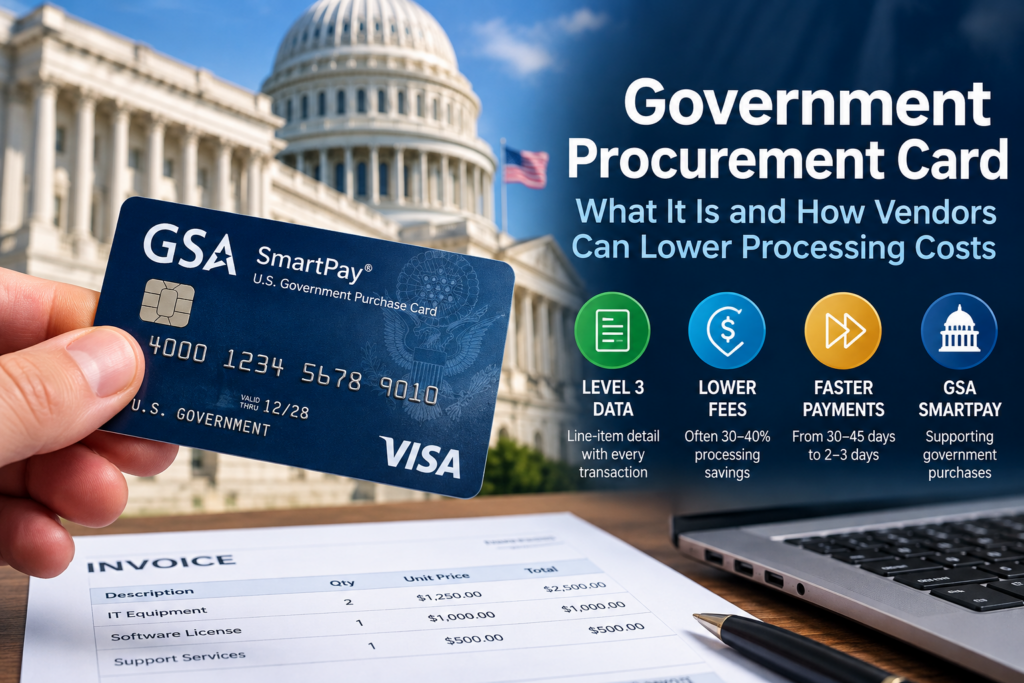
A government procurement card, also commonly referred to in the United States as a government purchase card, purchasing card, or P-card, allows government agencies to purchase goods and services directly from vendors using a commercial credit card. For merchants and government contractors accepting these cards, there is an important opportunity that is often overlooked: Visa and Mastercard have special interchange programs that can significantly lower the cost of accepting eligible government and commercial card transactions.
In fact, the U.S. General Services Administration (GSA) has stated that providing Level 3 transaction data can reduce a supplier’s credit card processing fees often by 30% to 40%.
The problem is that simply accepting a government procurement card doesn’t automatically mean your transactions are receiving these lower interchange rates.
What Is a Government Procurement Card?
A government procurement card is a commercial payment card used by government agencies and authorized employees to purchase goods and services.
In the U.S. federal government, these cards are more commonly referred to as Government Purchase Cards (GPCs). Procurement cards, purchasing cards and P-cards are also commonly used terms throughout commercial purchasing.
Rather than requiring a traditional invoice and check for every purchase, authorized cardholders can use these cards to purchase directly from approved vendors.
For vendors, one advantage is faster payment. GSA has explained that electronic card payments can reduce payment time from approximately 30–45 days for an invoice to 2–3 days for electronic payment.
But faster funding isn’t the only potential advantage.
Government Procurement Cards Can Qualify for Lower Interchange Rates
Many merchants don’t realize that not every credit card transaction carries the same underlying interchange cost.
Visa and Mastercard have established special commercial interchange programs that can provide lower interchange rates when eligible procurement, purchasing and government card transactions meet the necessary qualification requirements.
GSA specifically explains that Visa and Mastercard created special rates to support Purchase Card programs and reduce merchant interchange costs when Level 3 line-item detail is transmitted with the card payment. According to GSA, providing Level 3 data may reduce credit card processing fees often by 30% to 40%.
This is important because the processor’s markup is only one part of what a merchant pays to accept a government procurement card.
How the transaction qualifies at the interchange level can have a much larger impact on the final cost.
What Is Level 3 Data?
Level 3 data is essentially an electronic invoice that travels with the credit card transaction.
Instead of transmitting only basic payment information, Level 3 processing provides additional information about what was purchased.
According to GSA, Level 3 line-item data can include:
- Product description
- Quantity
- Unit of measure
- Price
- Discounts
- Sales tax information
- Merchant information
- Cardholder information
GSA describes Level 3 transactional data as identifying what is being purchased, how the sale takes place, who is involved in the transaction and when it occurs, and combining that information with the basic payment data transmitted to the issuer.
Providing this additional information gives the government and card issuer greater visibility into the transaction while also allowing eligible transactions to qualify for special commercial interchange programs.
Why Level 3 Data Can Lower Government Procurement Card Processing Costs
This is where government procurement card processing becomes very different from ordinary consumer credit card processing.
The interchange cost of a commercial card can vary significantly depending on how the transaction qualifies.
A government contractor could have an extremely competitive processing rate from its merchant processor and still be paying substantially more than necessary if its transactions are qualifying incorrectly or unnecessarily downgrading.
That’s why simply asking:
“What processing rate am I paying?”
doesn’t necessarily tell you whether your government procurement card processing is optimized.
The more important question is:
“How are my transactions actually qualifying at the interchange level?”
Visa Has Changed How Commercial Card Transactions Qualify
Visa has made significant changes to the way eligible commercial card transactions qualify.
Traditional Visa Level 3 qualification has transitioned to Visa’s Commercial Enhanced Data Program (CEDP) and Product 3 qualification for eligible commercial transactions.
Under Visa’s current published U.S. interchange schedule, eligible Corporate and Purchasing Card transactions that meet Commercial Product 3 requirements can qualify at 1.75% + $0.10.
By comparison, Commercial Card Not Present transactions can qualify at 2.70% + $0.10, while Commercial Non-Qualified transactions can reach 2.95% + $0.10.
That difference occurs at the interchange level before the processor’s markup is added.
So two government contractors could negotiate exactly the same processing rate with their processor and still have very different overall costs depending on how their government and commercial card transactions are qualifying.
GSA Large Ticket Rates for Government Procurement Cards
For government contractors accepting larger transactions, the potential difference can become even more significant.
Visa maintains a special GSA Large Ticket interchange category for eligible government Purchasing Card transactions.
The current published Visa GSA Large Ticket interchange rate is:
1.20% + $39
Visa’s regular Commercial Product Large Ticket rate is:
1.30% + $35
These programs can be particularly important for government contractors accepting larger purchasing-card payments because the percentage component of interchange is substantially lower than many standard commercial card categories.
However, accepting a large government procurement card transaction does not by itself guarantee that the transaction will receive a Large Ticket interchange rate. The transaction must meet the applicable qualification requirements.
The Problem: Many Government Vendors Aren’t Properly Set Up
One of the biggest misconceptions is that having a processor or gateway that “supports Level 3” automatically means government procurement card transactions are receiving the lowest interchange rates available.
That’s not necessarily the case.
Transactions can still qualify incorrectly or unnecessarily downgrade because of issues involving transaction data, processing configuration, card type, qualification requirements or how information is submitted with the transaction.
There can also be qualification issues outside of Level 3.
That’s why government contractors should look at the actual interchange qualification on their processing statements, rather than simply asking whether their processor supports Level 3.
Government Procurement Card Processing Can Be Automated
Years ago, Level 3 processing could require employees to manually enter additional transaction information every time they accepted a purchasing card.
Today, much of that process can be automated.
We’ve simplified this process with technology that runs behind the scenes to automatically optimize how transactions are qualifying. This includes optimizing commercial and B2B transactions, identifying unnecessary downgrades, and correcting other qualification issues that increase costs.
The goal is simple: make sure your transactions are qualifying at the lowest interchange rates, without your staff having to manage the process or figure out what’s a normal interchange cost and what’s an unnecessary downgrade.
This can be especially valuable for government contractors processing a significant volume of procurement cards, purchasing cards and other commercial cards.
GSA SmartPay and Government Purchase Cards
The federal government’s GSA SmartPay program is one of the world’s largest commercial payment programs and includes cards used by federal agencies for purchasing goods and services.
GSA has specifically promoted Level 3 transaction data because of the additional detail it provides with government purchases.
According to GSA, Level 3 data creates additional transparency and accountability by transmitting detailed information about the goods or services being purchased.
For vendors, GSA has also highlighted the financial benefit: special Visa and Mastercard Purchase Card interchange rates can reduce merchant transaction costs when the appropriate Level 3 information is transmitted.
Does Your Processor Support Government Procurement Card Optimization?
This is an important distinction.
A processor may be capable of accepting government procurement cards without necessarily optimizing how those transactions qualify.
Likewise, a gateway may technically support enhanced data without automatically supplying or managing all of the information required for the best available interchange qualification.
Government contractors should therefore look beyond whether their processor simply accepts purchasing cards and ask:
Are my government procurement card transactions actually qualifying at the lowest interchange rates available?
How Much Could a Government Contractor Save?
There isn’t one savings percentage that applies to every merchant.
Savings depend on factors including:
- Current interchange qualification
- Types of cards accepted
- Average transaction size
- Government versus commercial card volume
- Existing processing technology
- Whether transactions are unnecessarily downgrading
- Eligibility for Product 3 or Large Ticket programs
However, GSA itself has stated that suppliers providing Level 3 data may reduce credit card processing fees often by 30% to 40%.
For companies processing significant government purchasing-card volume, even a relatively small improvement in interchange qualification can represent substantial annual savings.
Are Your Government Procurement Card Transactions Qualifying Correctly?
If your company accepts government procurement cards, Government Purchase Cards, purchasing cards, P-cards or other commercial credit cards, don’t assume you’re receiving the lowest available interchange rates simply because your processor says it supports Level 3.
The only way to know is to look at how the transactions are actually qualifying.
Revolution Payments can perform a no-obligation interchange audit to review your current processing, identify unnecessary downgrades and determine whether your government and commercial card transactions are receiving the interchange rates available to them.
If everything is already optimized, we’ll tell you that too. Questions? Give us a call at 888 790 3450 or email info@ revolution-payments.com