
Government Contractor Profit Margins: The Hidden Costs Eating Into Your Profits
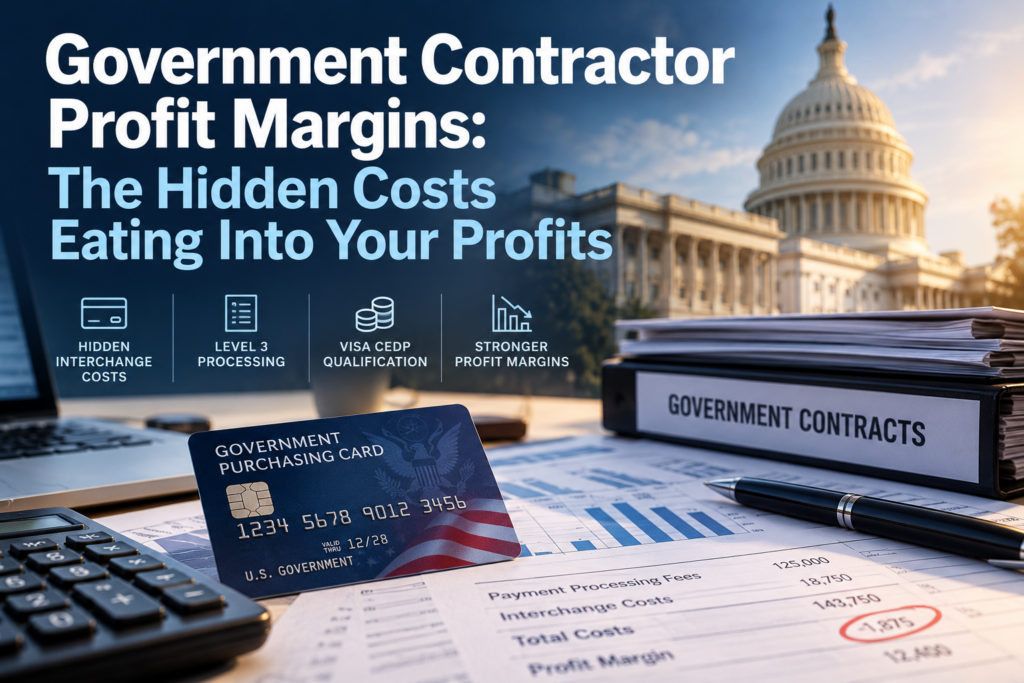
Government contractor profit margins are under increasing pressure. Between rising labor costs, growing compliance requirements, competitive contract pricing, and delayed payments, government contractors are being asked to do more with less. While winning additional contracts can increase revenue, it doesn’t necessarily translate into higher profits.
With margins shrinking, it’s more important than ever for government contractors to identify opportunities to improve their bottom line without having to increase sales.
One of those opportunities is often overlooked, even by experienced financial teams: the hidden interchange costs associated with accepting government purchasing cards.
Why Government Contractor Profit Margins Are Shrinking
Government contractors face financial challenges that extend well beyond winning new business.
Rising labor expenses, administrative overhead, compliance requirements, and competitive bidding pressures can all reduce profitability. Contractors operating under fixed-price agreements may face additional challenges when actual costs exceed what was originally anticipated.
Even companies experiencing significant revenue growth can find themselves working harder while earning less.
As a result, financial teams are increasingly focused on controlling expenses, improving operational efficiency, and identifying opportunities to protect profit margins.
However, one expense that often receives surprisingly little attention is the cost of accepting credit cards.
For government contractors accepting purchasing cards, overlooking this expense can mean leaving substantial savings on the table.
The Hidden Interchange Costs Most Government Contractors Overlook
When businesses evaluate their credit card processing costs, most of the attention naturally goes toward the processor’s rate.
That makes sense. It’s the part of the cost they’re familiar with, and it’s typically what payment processors focus on when competing for business.
But here’s what many government contractors don’t realize.
Up to 90% of the fees businesses pay to accept credit cards don’t even come from their processor. They come from interchange.
Interchange represents the underlying cost associated with accepting different types of credit cards. These rates vary depending on the card type, transaction details, and how the transaction qualifies.
While businesses can negotiate their processor’s markup, interchange rates are established through the card networks and are subject to specific qualification requirements.
The challenge is that while companies regularly review and negotiate their processor’s rates, the interchange portion is rarely examined or checked for accuracy.
And that’s where some of the largest opportunities to reduce payment acceptance costs can be found.
Special Interchange Programs Can Reduce Costs by 30% to 40%
For more than 20 years, special interchange programs have existed to help reduce the cost of accepting government purchasing cards and other eligible commercial cards.
When transactions qualify for these programs, interchange costs can often be reduced by 30% to 40%.
However, simply accepting government purchasing cards doesn’t automatically mean a contractor is receiving those benefits.
An estimated three out of five government contractors are not properly configured to take full advantage of these programs.
Some aren’t submitting the required Level 3 transaction data. Others may already be submitting Level 3 data but still aren’t receiving the available interchange incentives because of how their transactions are configured or submitted.
This distinction is important.
A contractor can have Level 3 processing enabled and still experience unnecessary interchange downgrades if the required information isn’t being transmitted correctly or the transactions aren’t meeting the applicable qualification requirements.
As a result, contractors may be paying significantly more than necessary on transactions that could otherwise qualify for reduced interchange rates.
How Visa’s CEDP Changes Affect Government Contractors
Recent changes by Visa have made proper interchange qualification even more important.
Visa eliminated its previous Level 2 interchange program for business cards and introduced new enhanced-data requirements through the Commercial Enhanced Data Program (CEDP).
Under the newer CEDP framework, simply submitting Level 3 data doesn’t automatically guarantee that a transaction qualifies for the lowest available interchange rates.
Eligible transactions must meet the applicable enhanced-data requirements, including Visa’s verification standards, to receive the appropriate Product 3 interchange incentives.
These changes can have a significant impact on government contractors accepting business, purchasing, and commercial cards.
Even contractors that previously had Level 3 processing in place may need to reevaluate how their transactions are being submitted.
A payment system configured several years ago may no longer be optimized for today’s interchange requirements.
And when transactions don’t qualify correctly, the additional costs can add up quickly.
How Interchange Fees Impact Government Contractor Profit Margins
Consider a government contractor accepting $500,000 per month in government purchasing card payments.
If those transactions are qualifying at interchange rates just 1 percentage point higher than necessary, that represents an additional $5,000 per month in payment acceptance costs.
That’s $60,000 annually coming directly out of the company’s bottom line.
If the difference is 1.5 percentage points, the additional cost increases to $90,000 annually.
These are illustrative examples of potential qualification differences on eligible card transactions, not guaranteed savings.
For contractors already operating on tight margins, recovering even a portion of those unnecessary costs can make a meaningful difference.
And unlike increasing revenue, reducing unnecessary interchange costs doesn’t require winning another contract, hiring additional employees, or increasing prices.
The opportunity may already exist within the transactions being processed today.
Lowering Interchange Costs Without Changing Processor Rates
One of the biggest misconceptions about credit card processing is that reducing costs requires negotiating a lower rate with the processor or switching processing companies.
That’s not necessarily the case.
Two businesses can have identical processor pricing yet pay significantly different amounts to accept the same types of cards, based solely on how their transactions qualify at the interchange level.
Revolution Payments, a veteran-owned payment processing company with more than 30 years of industry experience, specializes in identifying these types of interchange qualification issues.
In one client example, correcting how transactions qualified reduced payment acceptance costs by more than $50,000 per month.
What’s particularly interesting is that the processor’s rate wasn’t lowered. The savings came from correcting and optimizing how transactions were qualifying at the interchange level.
Other client examples have produced even greater savings.
While results vary based on transaction volume, card types, and existing qualification levels, these examples demonstrate why reviewing interchange can be considerably more valuable than focusing exclusively on the processor’s markup.
How Automation Helps Contractors Qualify for Lower Interchange Rates
Historically, qualifying transactions for reduced interchange rates required businesses to capture and submit additional transaction information, including detailed Level 3 data.
This often involved product descriptions, quantities, tax information, and other transaction-level details.
Today, much of that process can be automated.
With the proper technology and configuration, eligible transactions can be submitted with the enhanced data required by applicable interchange programs without requiring staff to manually manage the process.
Depending on the transaction and card type, these opportunities may include:
- Government purchasing card interchange optimization
- Automated Level 3 transaction data
- Visa Commercial Enhanced Data Program (CEDP) qualification
- Eligible large-ticket interchange programs
- Identification and correction of unnecessary interchange downgrades
- Automated transaction qualification and reporting
The goal is straightforward: ensure eligible transactions are qualifying at the lowest applicable interchange rates without adding unnecessary administrative work.
For government contractors already dealing with rising overhead and compliance requirements, automation can help reduce payment acceptance costs without creating additional responsibilities for accounting or administrative teams.
Improving Government Contractor Profit Margins Without Increasing Sales
Government contractors are facing increasing pressure to control expenses while remaining competitive.
Rising operating costs, tighter contract pricing, compliance obligations, and unpredictable payment cycles can all make it more difficult to maintain healthy profit margins.
While many of these challenges are outside a contractor’s immediate control, unnecessary interchange costs may be something they can address.
And unlike increasing sales, correcting payment qualification issues doesn’t require winning additional contracts or expanding operations.
For contractors accepting government purchasing cards, the question is simple:
Are those transactions actually qualifying for the lowest interchange rates they’re eligible to receive?
If the interchange portion of processing costs hasn’t been reviewed recently, there may be an opportunity to improve profitability without changing the processor’s rate.
Request a No-Obligation Interchange Audit
Revolution Payments helps government contractors and B2B suppliers identify unnecessary interchange costs through automated Level 3 processing, Visa CEDP optimization, and other interchange qualification programs.
A no-obligation interchange audit can help determine whether transactions are qualifying correctly, identify unnecessary downgrades, and uncover opportunities to reduce payment acceptance costs.
For contractors looking to protect profit margins without increasing sales, reviewing interchange may be one of the most overlooked opportunities available.
Contact Revolution Payments to request a no-obligation interchange audit.