
How Government Contractors Get Paid — And What It Costs When They Do
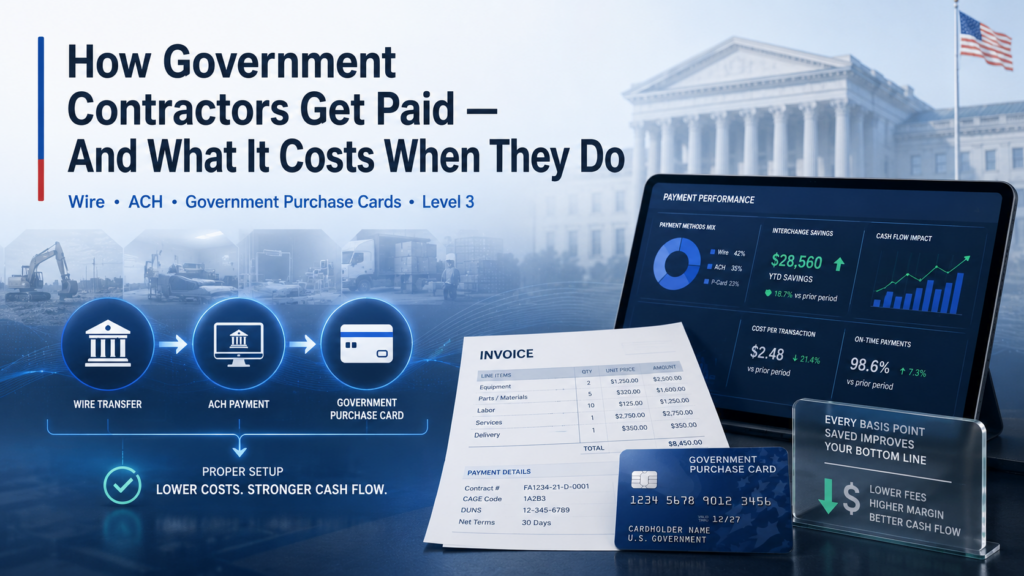
Understanding how government contractors get paid is one of the most practical — and most overlooked — aspects of doing business with the federal government. There are more resources than ever to help contractors win government contracts. The gap is on the other side: once the contract is awarded and the work is delivered, most contractors have never been shown how to get paid in the most economical way. That gap has existed for more than 20 years and it is still costing contractors real money on every eligible transaction.
There are countless programs and consultants that help businesses win government contracts. Almost none of them address what happens on the payment side once the contract is awarded — and that gap is costing contractors and vendors real money on every transaction.
How Government Contractors Get Paid — The Three Main Methods
Government contractors and vendors typically receive payment through one of three methods — wire transfer, ACH, or government purchase card. Each has different implications for cash flow, administrative burden, and in the case of purchase cards, the cost of accepting the payment itself.
Wire transfers are used for larger contract payments where speed is prioritized. The government initiates the transfer directly to the contractor’s bank account. Funds typically arrive within one to two business days once processed. Wire transfers carry no merchant processing cost on the contractor’s side — the full contract amount arrives without deduction.
The limitation is that wire transfers require manual initiation on the government’s side and are generally used for larger, less frequent payments rather than routine purchase transactions.
ACH is the most common method for routine government contractor payments processed through standard invoicing systems such as the Invoice Processing Platform (IPP) for civilian agencies or Wide Area Workflow (WAWF) for DoD contracts. Once an invoice is approved, ACH payments typically arrive within one to three business days.
Like wire transfers, ACH payments carry no merchant processing cost — the contractor receives the full invoiced amount. The challenge with ACH through the standard invoicing process is that payment timelines depend on invoice approval, which can take 30 days or more under the Prompt Payment Act. During that window, contractors are effectively floating the cost of the work they have already performed.
Government purchase cards — issued through programs such as GSA SmartPay — are used by federal purchasing agents to pay vendors directly at the point of sale or through an invoice payment process. Many of these cards operate on the Visa and Mastercard networks.
Purchase card payments offer a significant cash flow advantage over traditional invoicing — funds typically settle within two to three business days rather than waiting for the full invoice approval cycle. However, unlike wire and ACH payments, purchase card transactions carry an interchange cost that the merchant absorbs. How that interchange cost is managed determines how much of the contract value the contractor actually keeps.
GSA SmartPay guidance notes that purchase card payments improve vendor profitability by reducing payment time from 30 to 45 days on a traditional invoice to 2 to 3 days for electronic payment. For contractors and vendors managing cash flow across multiple contracts, that difference is significant — but it comes with an interchange cost that most have never been shown how to minimize.
How Government Contractors Get Paid by Purchase Card — And What It Actually Costs
When a government purchasing agent pays by purchase card, the contractor or vendor accepts the payment through their merchant account and the funds settle in two to three business days. What most contractors and vendors do not know is that the cost of accepting that payment — the interchange — is not fixed. It varies significantly depending on how the merchant account is configured and whether the right transaction data is being submitted with each payment.
Visa and Mastercard created specific interchange programs for government purchase card transactions more than 20 years ago. The intent was to encourage vendors to submit detailed line-item data with each transaction — and reward them with lower interchange rates when they did. According to the GSA Federal Acquisition Service, by providing Level 3 data, a supplier may reduce their credit card processing fees — often by 30 to 40 percent.
“There are programs to help contractors win government business and programs to help them manage their contracts. Almost nothing exists to show them how to get paid in the most economical way once the contract is in hand.”
What Level 3 Processing Means for How Government Contractors Get Paid
Level 3 credit card processing refers to the submission of detailed line-item transaction data with each purchase card payment — information that mirrors what would appear on an itemized invoice. This includes the purchase order or customer code, item description, quantity, unit of measure, unit cost, tax amount, freight amount, and ship-to and ship-from postal codes.
When this data is submitted correctly with each eligible government purchase card transaction, the transaction qualifies for a lower interchange category. On eligible transactions, the difference can be 30 to 40 percent compared to a standard card submission. Across repeated government purchase card payments, that adds up quickly.
Level 3 processing is not something that happens automatically. The merchant account must be specifically configured to capture and submit the required data fields on each eligible transaction. Many contractors and vendors whose accounts technically support Level 3 are still not receiving the full benefit because the configuration is incomplete or the required fields are not transmitting correctly on every transaction.
Large Ticket Government Purchase Card Transactions — A Program Most Contractors Don’t Know Exists
For government contractors and vendors regularly receiving large purchase card payments, there is a separate Visa interchange program specifically for GSA large ticket transactions that offers even lower rates for eligible payments above a certain threshold.
As of August 2026, the Visa GSA Large Ticket interchange rate is 1.20% + $39.00 per transaction for eligible transactions of $5,557.14 and above. These rates are subject to change — contractors should verify current thresholds and rates with their processor.
| Program | Threshold | Rate (August 2026) | Requirement |
|---|---|---|---|
| Non-Qualified | Any amount | 2.95% + $0.10 | Missing or incomplete data |
| Standard P-Card | Any amount | 2.70% + $0.10 | Basic transaction data |
| CEDP Verified / VL3V | Any amount | 1.75% + $0.10 | Level 3 line-item data required |
| Visa GSA Large TKT | $5,557.14 and above | 1.20% + $39.00 | Level 3 line-item data required |
For a contractor receiving a $10,000 purchase card payment, the difference between a standard interchange rate and the GSA large ticket rate can represent $100 or more on a single transaction. At meaningful volume — multiple large purchase card payments per month — that difference is significant annual cost.
Qualifying for the Visa GSA Large Ticket interchange rate requires Level 3 line-item data to be submitted correctly with each eligible transaction. The merchant account must also be specifically configured for this program. Simply accepting government purchase cards above the threshold is not sufficient — the account setup determines whether the lower rate is available.
Who This Matters For
This matters for any business that accepts credit card payments from the government. The opportunity is not limited to one industry, one type of contractor, or only large-ticket transactions. If a federal, state, municipal, military, institutional, or government-related buyer is paying by purchase card, commercial card, or government card, the way that transaction is submitted can directly affect the interchange cost.
Level 3 processing can apply to eligible government and commercial card payments when the merchant account and gateway are configured correctly and the required transaction data is submitted properly. For businesses that also receive larger government card payments, there may be an additional opportunity to qualify for large ticket interchange programs. But the first step is the same: confirming whether the account is actually set up correctly and whether transactions are clearing at the best available interchange category.
What Government Contractors Should Know About Getting Paid Correctly
Understanding how government contractors get paid is only part of the picture. Understanding what it costs — and how to reduce that cost — is where most contractors are missing out. Here is what to verify regardless of how long a contract has been in place:
- Is the merchant account configured for Level 3 data submission? Standard merchant accounts and credit card terminals typically do not submit Level 3 data automatically. A Level 3 capable gateway is required and must be properly configured.
- Are the required data fields actually transmitting on every transaction? Many accounts that technically support Level 3 are missing specific fields — such as the purchase order or customer code — that are critical for interchange qualification.
- Are purchase card transactions qualifying at the expected interchange level? A statement review will show what interchange categories transactions are actually clearing at — not what they should be clearing at based on the account setup.
- Do large purchase card payments qualify for GSA large ticket rates? Transactions above $5,557.14 may qualify for the Visa GSA Large Ticket interchange rate of 1.20% + $39.00 — but only with correct Level 3 data submission and proper account configuration.
- Are there STND or EIRF charges on the processing statement? These codes indicate transactions that downgraded — meaning required data was missing and the transaction did not qualify for the lower interchange rate available.
How Revolution Payments Approaches Government Contractor Payment Processing
Revolution Payments has specialized in government contractor and vendor payment processing for over 25 years. The interchange optimization programs that Visa and Mastercard created for government purchase card transactions have been available since the program launched — but more than two decades later, most contractors and vendors are still not set up correctly to benefit from them.
Some are set up but not configured in a way that actually generates the interchange savings the program was designed to provide. That is the gap that Revolution Payments was built to address — not just getting a merchant account approved, but making sure government purchase card transactions qualify correctly on every eligible payment.
For any contractor asking how government contractors get paid — and more specifically, how to reduce what it costs when they do — a no-cost statement review will show exactly where purchase card transactions are currently qualifying and whether there is anything worth addressing.
Accepting Government Purchase Cards?
Find out whether purchase card transactions are qualifying at the right interchange level — and whether Level 3 or GSA large ticket rates apply to the volume being processed.
Call 888-790-3450 — Free Statement Review No obligation · No long-term agreements · Revolution Payments · 25+ Years Government Payment Experience info@ revolution-payments.com