
Surcharging Government Purchase Cards — What Government Contractors Need to Know
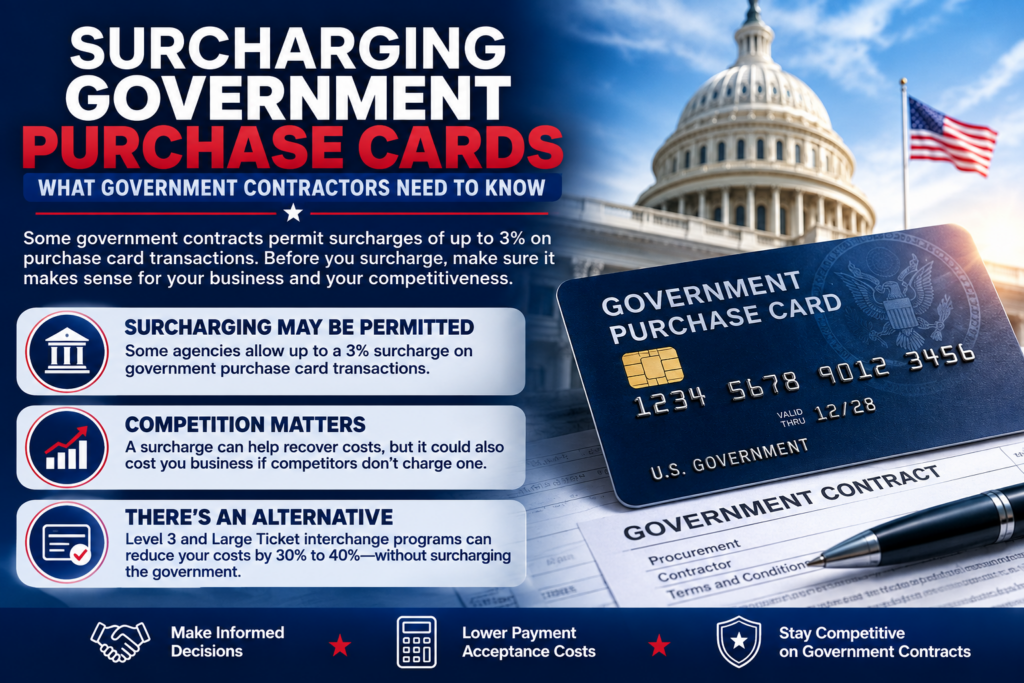
Some government contractors are permitted to do surcharging on government purchase card transactions. Whether doing so makes sense is a different question — and for contractors who choose not to surcharge, there is a path to significantly lower interchange costs that most processors never mention.
The question of whether government contractors can surcharge government purchase cards is coming up more frequently. In fact, Revolution Payments has recently spoken with multiple contractors whose government contracts permit a surcharge of up to three percent on purchase card transactions. Over the past 25 years working specifically with government contractors, the payment side of contract performance is still one of the least discussed — and most costly — areas that new and established contractors overlook.
Can Government Contractors Surcharge Government Purchase Cards?
A government contractor surcharge program allows a vendor to add a fee to the transaction when a government purchasing agent pays by purchase card. This fee is intended to offset the merchant’s cost of accepting the credit card — passing some or all of that cost back to the agency making the purchase.
Whether a government contractor can surcharge depends on the specific contract terms, the agency, and applicable regulations. Some contractors working with certain agencies are permitted to charge up to three percent. Others are not. Before implementing any surcharge on government purchase card transactions, the contract terms should be reviewed carefully and confirmed with the contracting officer.
Revolution Payments works with contractors in specific agencies where the purchasing office has confirmed they will accept a surcharge of up to three percent. In those situations, a properly implemented surcharge program can offset the majority of the processing fees a contractor would otherwise absorb. Understanding whether that applies to a specific contract is the starting point of the conversation.
GSA SmartPay guidance notes that A/OPCs should ensure card holders are aware of the possibility of surcharges when making purchases using GSA SmartPay charge cards. If a merchant is imposing a surcharge, the card holder may choose to consider another merchant that offers the same or similar item without the surcharge. This is an important competitive consideration for any government contractor evaluating a surcharge program.
Surcharging Government Purchase Cards — Why Competition Matters
Even when a government contractor surcharge program is permitted under contract terms, the decision to implement one involves more than just whether it is allowed. The competitive implications are real and worth understanding before proceeding.
Government purchasing agents who encounter a surcharge have the option to seek out another vendor offering the same or similar products or services without one. In a competitive procurement environment — where multiple vendors offer comparable capabilities — a surcharge can be a factor that moves business to a competitor. This is particularly relevant for contractors whose products or services are not highly differentiated or where the agency has multiple qualified vendors to choose from.
A government contractor surcharge program that recovers three percent in processing costs may cost significantly more in lost contract value if purchasing agents consistently choose vendors who do not surcharge. The decision should factor in the competitive landscape, the nature of the contract, and whether the agency has readily available alternatives.
For contractors in specialized fields — where the agency has few qualified vendors — the competitive risk of surcharging may be lower. For contractors in more commoditized categories, the risk of losing business may outweigh the benefit of recovering processing costs through a surcharge.
“The decision to surcharge is not just about whether it is permitted — it is about whether the business can absorb the competitive risk of charging an agency more than a competitor would.”
When Surcharging Government Purchase Cards Isn’t the Right Fit
For government contractors who determine that surcharging is not the right fit — either because it is not permitted under their contract or because the competitive risk is too high — the more effective path to reducing the cost of accepting government purchase cards is through interchange optimization.
Visa and Mastercard created specific interchange programs for government purchase card transactions that significantly reduce the cost when the right transaction data is submitted. According to the GSA Federal Acquisition Service, by providing Level 3 data, a supplier may reduce their credit card processing fees — often by 30 to 40 percent. This cost reduction does not require surcharging the agency, does not create a competitive disadvantage, and is available on eligible transactions when the merchant account and transaction data are configured correctly.
The GSA has published examples showing the real dollar difference. A $5,000 Visa transaction without Level 3 data costs approximately $139 (2.78%) in interchange. The same transaction with Level 3 data costs approximately $99 (1.98%). For contractors processing significant government purchase card volume, that difference compounds quickly across every eligible transaction.
Surcharging Government Purchase Cards vs. Level 3 — Understanding Your Options
For contractors permitted to surcharge up to three percent, the surcharge effectively passes the full processing cost to the agency. For contractors who optimize through Level 3 processing instead, the interchange cost itself is reduced by 30 to 40 percent on eligible transactions — meaning the contractor pays significantly less without passing any cost to the agency.
For contractors who choose not to surcharge government purchase cards, Level 3 interchange optimization reduces the underlying interchange cost without passing any additional charge to the government customer. That distinction matters — the contractor pays less, and the agency pays nothing extra.
GSA Large Ticket Interchange — A Program Most Contractors Don’t Know About
Beyond standard Level 3 interchange optimization, there is a separate Visa interchange program specifically for GSA large ticket transactions that offers even lower rates for eligible government purchase card transactions above a certain dollar threshold.
As of August 2026, the Visa GSA Large Ticket interchange rate is 1.20% + $39.00 per transaction for eligible transactions of $5,557.14 and above. These rates are subject to change — contractors should verify current thresholds and rates with their processor.
| Program | Threshold | Rate (as of August 2026) | Data Required |
|---|---|---|---|
| Standard — No Level 3 | Any amount | 2.70% + $0.10 | Basic transaction data only |
| Level 3 — Government Purchase Card | Any amount | 1.90% + $0.10 | Level 3 line-item data required |
| Visa GSA Large Ticket | $5,557.14 and above | 1.20% + $39.00 | Level 3 line-item data required |
For a government contractor regularly processing transactions above the GSA large ticket threshold, the difference between paying standard interchange and qualifying for the GSA large ticket rate is significant. On a $10,000 transaction, standard interchange at 2.70% costs $270. The GSA large ticket rate at 1.20% + $39.00 costs $159 — a difference of $111 on a single transaction. At meaningful volume, that difference adds up to thousands of dollars per year.
Qualifying for the Visa GSA Large Ticket interchange rate requires Level 3 line-item data to be submitted correctly with each eligible transaction. Without Level 3 data, the transaction will not qualify for the large ticket rate regardless of the transaction amount. The merchant account must also be properly configured for this program — simply accepting government purchase cards is not sufficient.
What Government Contractors Should Evaluate Before Deciding
- Review contract terms first — confirm whether a surcharge is permitted under the specific contract and agency before implementing any government contractor surcharge program
- Assess the competitive landscape — how many qualified vendors does the agency have access to, and how likely are purchasing agents to seek out non-surcharging alternatives
- Understand the Level 3 opportunity — before surcharging, determine whether the merchant account is configured to submit Level 3 data correctly and whether interchange optimization alone would adequately reduce costs
- Check transaction sizes against the GSA large ticket threshold — if transactions regularly exceed $5,557.14, the GSA large ticket interchange program may reduce costs significantly without any surcharge
- Verify the current setup — many government contractors assume their account is configured correctly for Level 3 and large ticket programs. A statement review will confirm whether transactions are actually qualifying at the expected interchange levels
Revolution Payments and Government Contractor Payment Processing
Revolution Payments has specialized in government contractor payment processing for over 25 years. Government purchase cards — including GSA SmartPay cards — represent a meaningful portion of federal procurement spending, and contractors who are not set up correctly are paying more than necessary on every eligible transaction.
Whether the question is whether a government contractor surcharge program makes sense for a specific contract, or whether the current merchant account is configured to qualify for Level 3 and GSA large ticket interchange rates, a no-cost statement review will show exactly where transactions are currently qualifying and what options are available.
Accepting Government Purchase Cards?
Find out whether current transactions are qualifying at the right interchange level — and whether a government contractor surcharge program, Level 3 optimization, or GSA large ticket rates make the most sense for the contract and volume.
Call 888-790-3450 — Free ReviewNo obligation · No long-term agreements · Revolution Payments · 25+ Years Government Payment Experience