
Won a Government Contract — Now What About Getting Paid Correctly?
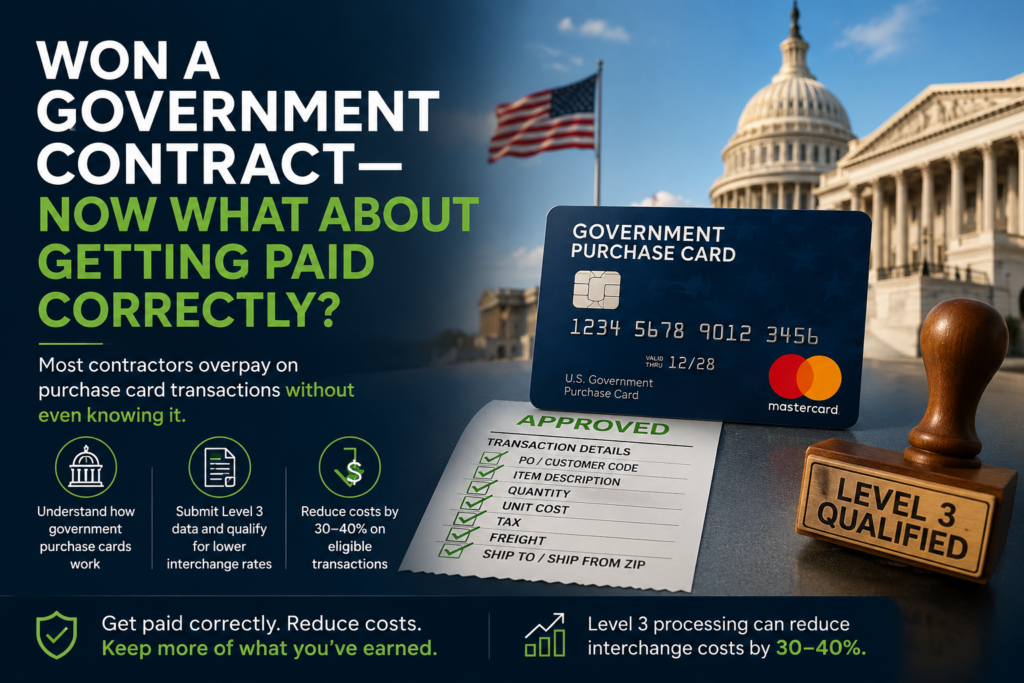
For any contractor asking won a government contract now what — the answer almost never includes what to do about accepting payments correctly. Winning a government contract is a significant achievement — and the government contracting industry has built an entire ecosystem around helping businesses get there. SAM.gov registration services, proposal writers, CAGE number consultants, bid monitoring platforms, and procurement advisors all exist to help contractors win. But once a contractor wins a government contract, the question of how to accept the payment correctly is almost never addressed — and after more than 25 years in government payment processing, the gap is still as wide as it has ever been.
How Does the Government Pay Contractors?
Many government agencies pay contractors using Government Purchase Cards — also called GPCs or P-Cards. Many of these purchase cards operate on the Visa and Mastercard networks. They look like any other credit card on the surface, but they carry more capabilities, controls, and data requirements than a standard consumer card.
Accepting a government purchase card correctly is different from simply being able to run a credit card. The transaction must include specific line-item data that goes beyond what a standard credit card transaction captures — and the merchant account must be configured to submit that data automatically with each eligible transaction. Without that configuration, the card processes but the transaction does not qualify for the lower interchange rates that Visa and Mastercard created specifically for government purchase card transactions.
The U.S. General Services Administration describes Level 3 transaction data as an “electronic invoice” with line-item details — defining what is being purchased, how the sale takes place, who is involved, and when it takes place. The GSA notes that by providing Level 3 data, a supplier may reduce their credit card processing fees — often by 30 to 40 percent.
Won a Government Contract — Now What Happens With the Payment?
When a contractor wins a government contract and begins accepting government purchase cards, the assumption is usually that having a merchant account is sufficient. The card processes, the money arrives, and the transaction appears to have worked. What most contractors never find out is whether that transaction qualified correctly — or whether it cleared at a rate significantly higher than it needed to.
Visa and Mastercard created specific interchange programs approximately 30 years ago to encourage government vendors to submit additional line-item data with each purchase card transaction. The idea was straightforward — by entering more detailed information about what was purchased, how much was paid, and what the order number was, the transaction would qualify for a lower interchange rate. The government purchasing agent would receive better transaction data for reconciliation. And the vendor would pay less to accept the payment.
Thirty years later, according to Mastercard, 3 out of 5 government vendors are still not properly set up to accept government purchase cards — meaning they are not submitting the enhanced transaction data required to qualify for the lower interchange rates available on eligible transactions. Many who are set up are not receiving the full benefit because their account is not configured correctly. And most have no idea this is happening because nobody in the contracting process ever told them about it.
Being “properly set up” means more than simply having a merchant account that can run a credit card. It means the payment system is configured to capture and submit enhanced Level 3 line-item data with each eligible government purchase card transaction — information such as the purchase order or customer code, item description, quantity, unit of measure, unit cost, tax amount, freight amount, and ship-to and ship-from postal codes. Without this data submitting correctly on every eligible transaction, the lower interchange rates that Visa and Mastercard created for this purpose are not available.
What Happens When a Government Contract Vendor Is Not Set Up Correctly
When a government contractor accepts a purchase card without submitting the required Level 3 line-item data, the transaction clears at a standard interchange rate rather than the lower rate available for properly submitted government card transactions. The difference can be 30 to 40 percent of the interchange cost on that transaction — and it happens on every transaction, every month, for as long as the account remains incorrectly configured.
The contractor never receives a notice that this is happening. The statement shows the transactions processed. The money arrives. But the cost of accepting that payment is significantly higher than it should be — and the gap accumulates quietly over time.
A government contractor processing $500,000 per year in purchase card transactions who is not set up correctly may be paying significantly more in interchange costs than a contractor with the same volume whose eligible transactions are properly configured for Level 3 qualification. That difference is not driven by the processor’s rate — it comes from how the transactions qualify at the interchange level.
The Gap Nobody in Government Contracting Talks About
The government contracting industry has become sophisticated at helping businesses win contracts. There are platforms that monitor tens of thousands of bid sources daily, consultants who specialize in proposal writing and past performance documentation, and advisors who guide businesses through SAM.gov registration, CAGE numbers, and set-aside certifications.
None of that ecosystem addresses what happens after the contract is awarded and the first purchase card payment comes in. The assumption is that payment processing is a commodity — find a processor, get approved, and move on. For government contractors accepting purchase cards, that assumption is expensive.
“There are more resources than ever to help contractors win government business. The gap is on the other side — understanding how to accept those payments in the most economical way once the contract is in hand.”
How Government Purchase Card Interchange Programs Work
Visa and Mastercard created special interchange rates for government purchase card transactions to encourage vendors to submit detailed transaction data. When a vendor submits the required Level 3 line-item data with each purchase card transaction — including the purchase order number, item description, quantity, unit of measure, and other required fields — the transaction qualifies for a lower interchange category. The cost reduction can be 30 to 40 percent on eligible transactions compared to a standard submission.
The GSA Federal Acquisition Service published the following examples of the interchange cost difference:
Visa — $5,000 transaction: $139 (2.78%) without Level 3 data vs. $99 (1.98%) with Level 3 data
Visa — $3,000 transaction: $99 (3.30%) without Level 3 data vs. $75 (2.50%) with Level 3 data
Mastercard — $5,000 transaction: $147.50 (2.95%) without Level 3 data vs. $102.50 (2.05%) with Level 3 data
Mastercard — $3,000 transaction: $88.60 (2.95%) without Level 3 data vs. $77.58 (2.58%) with Level 3 data
These interchange programs are not something a contractor negotiates with their processor. Qualification is primarily driven by whether the account and transaction data are configured correctly to meet the applicable requirements.
Level 3 transaction data includes information that mirrors what would appear on an itemized invoice — purchase order number or customer code, item description, quantity, unit of measure, unit cost, ship-to and ship-from postal codes, tax amount, and freight amount. When this data is submitted correctly with each government purchase card transaction, the transaction has the best opportunity to qualify for the lower interchange rates Visa and Mastercard created for this purpose.
Won a Government Contract and Already Processing? Here’s What to Check
For contractors who have already won a government contract and are currently accepting purchase cards, the most important question is not what processor is being used or what rate was negotiated. The most important question is how those transactions are qualifying at the interchange level — and whether the account is configured to take advantage of the programs that exist specifically for government vendors.
- Is the account configured for Level 3 data submission? Standard merchant accounts and credit card terminals typically do not submit Level 3 data. A Level 3 capable gateway or virtual terminal is required.
- Is the purchase order or customer code field transmitting correctly? The PO number or customer code is one of the most critical fields for government purchase card qualification — and one of the most commonly missing.
- Are transactions qualifying at the correct interchange category? A statement review will show what interchange level government card transactions are clearing at and whether there is a gap between what is being paid and what should be paid with correct configuration.
- Is the processor experienced with government purchase card transactions? Processing a government purchase card is not the same as optimizing one. The processor’s experience with Level 3 configuration and government card interchange programs matters significantly.
- Are there STND or EIRF charges on the statement? These codes on a processing statement indicate transactions that downgraded — meaning required data was missing or incorrect and the transaction did not qualify for the lower interchange rate.
What Government Contractors Should Know Before Accepting Their First Purchase Card
For contractors who have recently won a government contract and are setting up payment processing for the first time, the decisions made at setup determine how transactions will qualify — and what they will cost — for as long as that account is in place.
The processor’s quoted rate is one factor — but it is not the primary driver of cost for government purchase card transactions. Interchange qualification is. A contractor with a very competitive processor rate who is not set up for Level 3 data submission will pay significantly more per transaction than a contractor with a slightly higher processor rate who is configured correctly for government card interchange programs.
Level-3processing.com specializes in helping government contractors set up merchant accounts that are configured correctly for purchase card acceptance from day one — including Level 3 data submission, PO descriptor configuration, and the interchange optimization programs that Visa and Mastercard created specifically for government vendors. A review of the current setup or a new account configuration takes a matter of days.
The Programs Are There — Most Contractors Just Don’t Know About Them
The interchange programs that reduce the cost of accepting government purchase cards have been in place for approximately 30 years. They were created specifically to benefit government vendors. They do not require negotiation, special certification, or additional fees. They simply require that the merchant account be configured correctly to submit the right data with each transaction.
After more than 25 years working with government contractors, the most common situation encountered is a contractor who won a government contract, has been accepting purchase cards for years, paying standard interchange rates, and had no idea that a program existed that could have reduced those costs on eligible transactions. The money was there. The program was there. The setup just was not.
For any contractor who has recently won a government contract — or who has been accepting government purchase cards and has never had a statement reviewed for interchange optimization — a no-cost review will show exactly how transactions are currently qualifying and whether there is anything worth addressing.
Just Won a Government Contract?
Find out whether the payment setup is configured correctly for government purchase card acceptance — and whether transactions are qualifying at the interchange level available for properly configured government vendor accounts.
Call 888-790-3450 — Free Review No obligation · No long-term agreements · Revolution Payments or email info@ revolution-payments.com